The technology
The proactive self-checkout secured with dual technology
With the developments in RFID technology as of 2026, it is now perfectly possible to proactively prevent the exorbitant theft-driven shrinkage at the self-checkout while the groceries are being paid for. This also removes the need for a costly and hard-to-enforce judicial network of repressive measures.
The core: a purpose-built Cyber-Physical System (CPS) compares the QR codes on the packaging with the additionally applied RFID tags during checkout — two-factor article authentication (2FA).
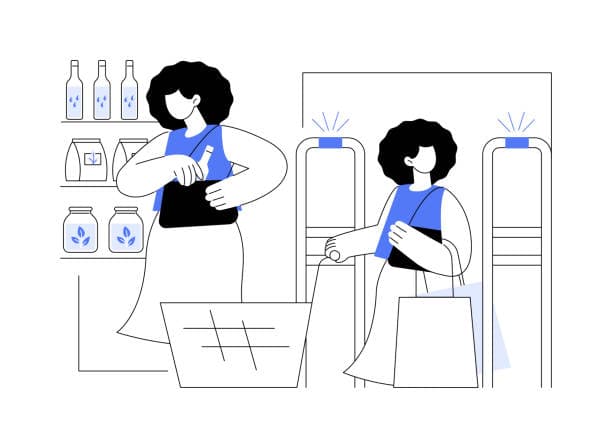
The ease with which groceries go unpaid — the problem dual technology tackles at the source.
How the CPS reduces shrinkage in three steps
- Step 1
Remote RFID scan
As soon as the customer checks in at the self-checkout, all groceries in the basket or trolley are scanned automatically in one go by an RFID reader built into the checkout system. The CPS program turns this into an RFID shopping list stored in the checkout system: the reference list against which the groceries scanned by the customer are verified.
- Step 2
Customer scans the QR codes
The customer scans the groceries one by one at the self-checkout, as usual, and places them on a conveyor belt that carries them to the packing area. Based on these manual scans, the CPS program simultaneously builds a QR shopping list that is also stored in the checkout system.
- Step 3
2FA validation by the CPS program
The CPS program compares both shopping lists simultaneously. If a product is missing, or something was not scanned correctly, the customer receives on-screen instructions on how to correct this. Only after correction can the payment be completed, the groceries be packed and the store be left.
The fundamental difference with today's self-checkout
In essence, the 2FA validation mirrors what the cashier used to do. Only now it is the CPS — instead of the cashier — that checks the trolley for groceries still to be paid for, and the CPS that moves the groceries to the packing area on the other side of the checkout. This can halve the throughput time per self-checkout.
Today's self-checkout
- After scanning the QR code — or not — groceries are placed back in the trolley or packed straight into the shopping bag.
- The store is then left, legally or not, by showing a receipt — or not.
- Checks happen afterwards and at random — frustrating for the well-meaning customer, and a favourite topic of complaint.
The CPS self-checkout
- Every scanned product goes straight onto the conveyor belt to the packing area — nothing disappears unchecked into a bag or trolley.
- The continuous, automated 2FA check replaces ad-hoc spot checks and all other unreliable, customer-unfriendly and privacy-sensitive methods.
- A robust solution that prevents shoplifting at the self-checkout — good for the retailer's business model and the consumer's peace of mind.
From the patent
The theft-proof CPS self-checkout system in pictures
The Cyber-Physical System described in the patent “Method and System for self-checkout at a point of sale” controls the security gate, the privacy gate and the product stop gate, and combines camera, RFID reader and QR scanner. Four situations describe the complete operation — from checking in to leaving the store.
A free checkout is recognisable by the open privacy gate. The customer can drive the trolley in right up to the closed security gate. Pressing the start button starts up the system, closing the privacy gate and the product stop gate.
Once scanning is done and payment completed, the system checks whether the previous customer has left the exit. Only then is the security gate opened. After the trolley has passed, the security gate closes and the product stop gate and privacy gate open.
The customer packs her groceries. The camera signals when she is done and has left the exit together with the trolley. The transaction is then closed and the system is ready for a new customer.
Until the camera has established that the previous customer has left the exit, the product stop gate remains closed. This prevents the new customer's groceries from ending up in the wrong bag.
A free checkout is recognisable by the open privacy gate. The customer drives the trolley in, right up to the closed security gate.
- The security gate can only be opened in two ways: by a store employee, or by the CPS system — after payment, or when a customer wants to leave the store without purchases.
- Anyone wanting to leave without purchases presses the ‘I want to leave the store’ button. The privacy gate and the product stop gate close; the camera checks the trolley or basket while the RFID reader checks for products carrying an RFID code.
- If the trolley contains products, the system asks whether the customer wants to pay or return the products. For returns, the system guides the customer step by step.
- If RFID codes are detected with an empty trolley, or products without any RFID code, security is alerted immediately: this may indicate intended fraud or deactivated tags.
- Customers who scanned with the app or hand scanner pay at a separate kiosk. There, the RFID scanner first verifies that all products have actually been scanned.
- Payment is only possible individually or as a group — the loophole of slipping out past waiting customers no longer exists.