The scale of the problem in figures
€ 1 billion
estimated annual loss for Dutch retail caused by theft at self-checkouts
1% → 2%
doubling of shrinkage in the supermarket sector since the large-scale introduction of self-scanning
40,000
shoplifting cases still registered by the police in 2025 — out of hundreds of thousands, according to research by the Dutch Ministry of Justice and Security
Proactive security puts an end to shoplifting at self-checkouts
Spot checks, exit gates, cameras and AI systems can detect fraud, but they do not prevent it. POS-2FA-Intermediary developed an anti-theft method that tackles the problem at its source: two-factor article authentication using QR codes and RFID tags.
Patented dual technology · 2FA
CPS self-checkout
2FA activeRFID list
QR list
2FA validation passed
Both shopping lists match — payment can be completed.
The problem
Reactive measures detect, but do not prevent
Rising shrinkage forced retailers into far-reaching anti-theft measures. These turn out to be ineffective, privacy-sensitive and rather customer-unfriendly. Shoplifting at self-checkouts can only be solved effectively by making the payment process reliable during scanning itself.
Spot checks & exit gates
Only check after the fact, regularly frustrate well-meaning customers and do not stop theft.
Cameras & AI systems
Can detect fraud, but do not prevent it — and raise privacy questions on top of that.
Staff acting as police officers
For store staff, having to play police officer is highly confrontational.
A retreating police force
The police are withdrawing ever further from the civil handling of shoplifting — the enforcement problem keeps growing.
The solution
From reactive to proactive prevention: preventing instead of checking afterwards
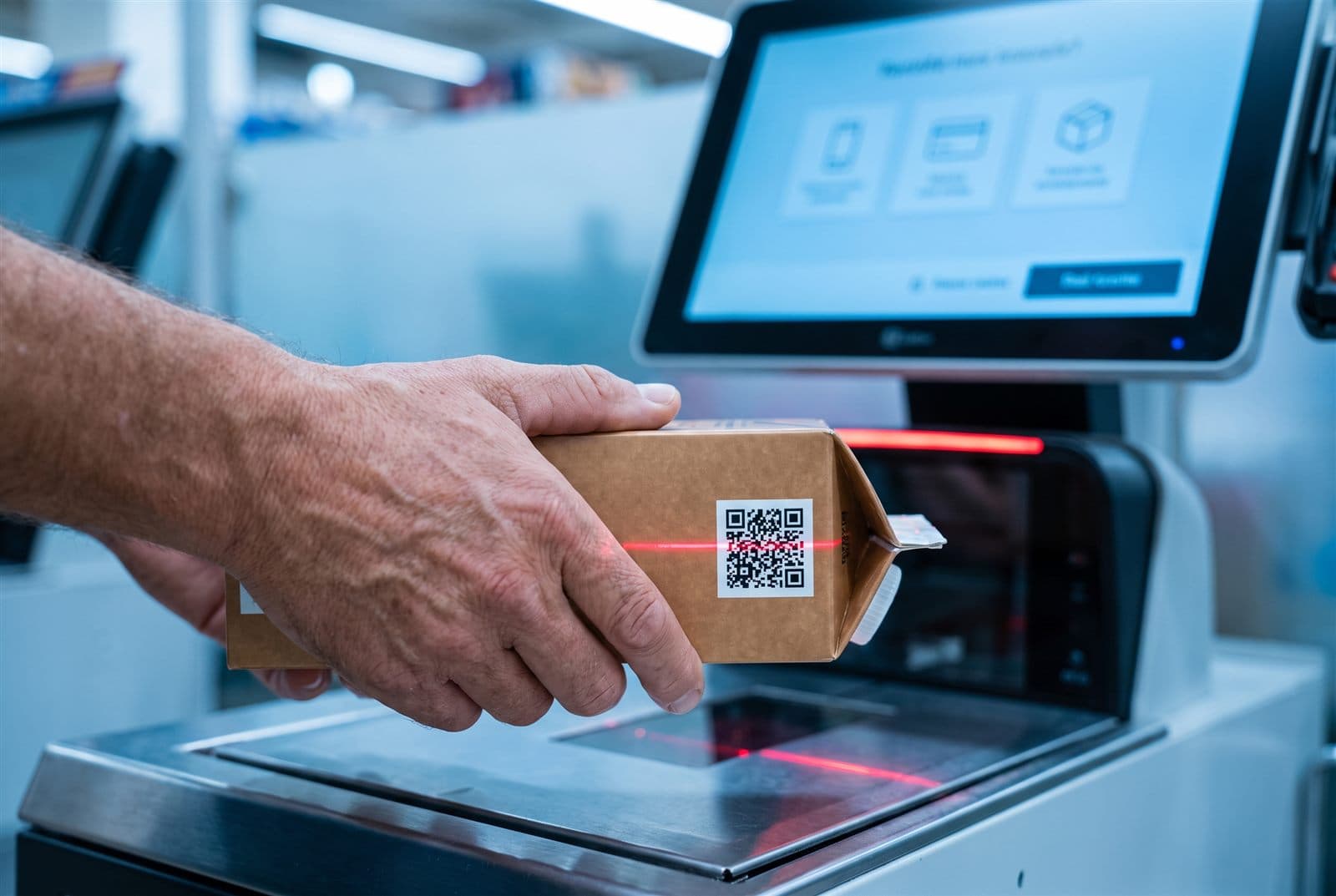
A purpose-built Cyber-Physical System (CPS) compares the QR codes on the packaging with the additionally applied RFID tags during checkout: two-factor article authentication (2FA) in three steps.
- Step 1
Remote RFID scan
As soon as the customer checks in at the self-checkout, all groceries in the basket or shopping trolley are scanned automatically in one go by the built-in RFID reader. The CPS program turns this into the RFID shopping list: the reference list.
- Step 2
Customer scans the QR codes
The customer scans the groceries one by one, as usual, and places them on a conveyor belt that carries them to the packing area. The CPS program simultaneously builds the QR shopping list.
- Step 3
2FA validation by the CPS
The CPS program compares both lists simultaneously. If a product is missing or something was not scanned correctly, the customer receives instructions on the screen. Only after correction can the payment be completed.
Why this works
A win-win for retailer and consumer alike
Preventing theft at the source
Robust, continuous and automated control by the CPS — instead of a costly and hard-to-enforce network of repressive measures.
Customer-friendly and privacy-aware
Ad-hoc spot checks and other unreliable, customer-unfriendly and privacy-sensitive security methods become a thing of the past.
Faster flow
The conveyor belt and the product stop gate allow two customers to use the same checkout at once: throughput time per self-checkout is halved.
Deposit-return intake at the checkout
With an adjustment of the CPS software, every secured self-checkout also serves as a return point for deposit packaging.
Good for the business model
The exorbitant shrinkage at the self-checkout is prevented proactively — and the intended savings of self-scanning are finally realised.
Relieving the enforcement burden
A proactive approach is also a fitting answer to the ever more pressing enforcement problem around shoplifting.
In essence, the CPS does what the cashier used to do: check the trolley for anything not yet paid for and move the groceries to the packing area. This can halve the throughput time per self-checkout.
See the full systemThe patent as the basis for partnership
POS-2FA-Intermediary is looking for a strategic buyer or licensing partner able to implement the patented technology worldwide.