Market & innovation
Point-of-sale innovations that matter
Fifty years of POS innovation turned the local corner shop into an international retail chain. Every leap — barcode, self-scanning, QR code, RFID — changed the checkout profoundly. The next step: making payment at the self-checkout reliable as well.
±50 years ago
The barcode transforms the checkout
On the initiative of Albert Heijn, Dutch retail started placing barcodes on packaging. The cashier no longer had to type in prices by hand: a simple beep of the barcode scanner took over. Long queues and input errors became a thing of the past — good for the retailer's business model, and customers loved it too.
±40 years ago
The first self-checkout
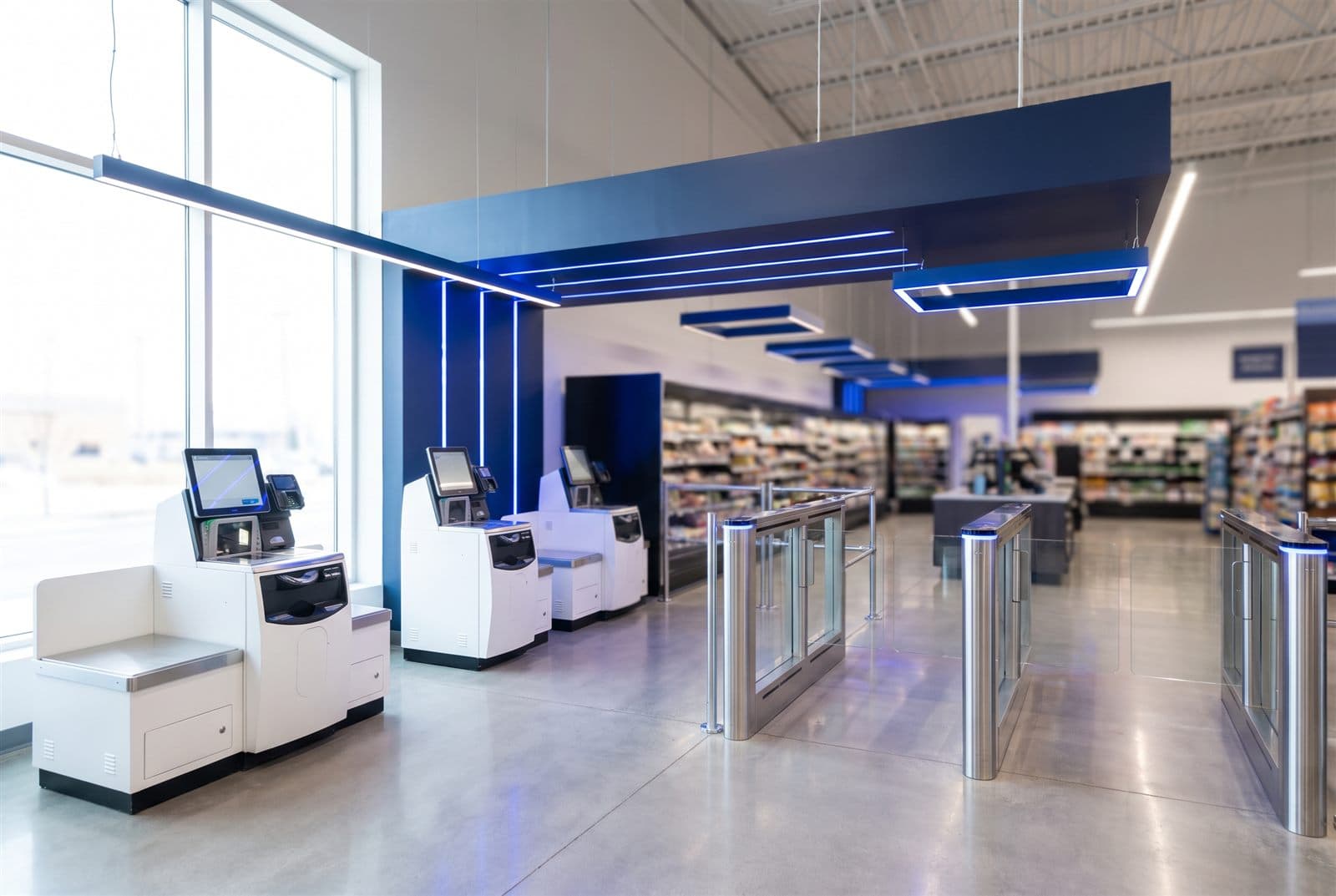
Albert Heijn introduced the very first self-checkout. It took about thirty years — partly due to the corona pandemic — for the concept to truly break through. It soon became clear, however, that the intended savings, especially for the FMCG retailer, were not being achieved, while the introduction caused an alarming rise in shoplifting.
1994
The QR code is developed
The QR code brought much faster information transfer and greater storage capacity than the barcode. For the FMCG retailer, this opened the way to an even more efficient and far more customer-friendly operation — think logistics and marketing.
Sunrise 2027
Worldwide switch to the GS1 Digital Link QR code
Through the Sunrise 2027 initiative, the barcode is being replaced worldwide by the new GS1 Digital Link QR code. Governments and legislators play a crucial role: consider the EU Digital Product Passport for regulation and sustainability, and the American FSMA 204 for food safety and traceability.
Today
RFID and dual technology
Current RFID developments create attractive new opportunities for a further efficiency leap in POS operations: a purpose-developed RFID tag on the packaging, alongside the already present GS1 Digital Link QR code. With a positive impact on the return on investment, this leads to better operational efficiency and optimised inventory management. GS1 is meanwhile considering how to harmonise the standardisation protocols for dual technology.
2026
The 2FA anti-theft method by POS-2FA-Intermediary
Together, all POS innovations drove the transition from the small local shop to the international retail chain — but the self-checkout also brought large-scale shoplifting with it. POS-2FA-Intermediary therefore developed an anti-theft method that tackles the problem at its source, using dual technology.
Connecting to Dutch retail developments
With the introduction of the self-checkout, the option of returning deposit products at the checkout disappeared. With the cashier gone and ever stricter legislation on recycling packaging materials, a dire shortage of return points has emerged.
The CPS checkout as a return point
This shortage can, where needed, largely be solved by adapting the CPS software: every self-checkout secured with dual technology can thereby also be made suitable as a return point for deposit products.
How the deposit-return intake worksHow the deposit-return intake works
The shortage of return points for deposit packaging can, where needed, largely be solved with the CPS self-checkout system. Every self-checkout secured with dual technology can then also serve as a return point for deposit products.
- When the groceries are scanned, the system establishes via the inventory database whether a product carries deposit packaging. The RFID tag is then not deactivated; instead, the CPS activates the code of an on/off switch that only sits on the RFID tags of deposit packaging.
- Later, when returning the deposit packaging, the customer can start the intake process via the ‘return deposit’ button. Because the RFID tags are still active and the on/off switch is on, the same scanning procedure can be followed — now with dedicated RFID and QR packaging lists instead of shopping lists.
- An extra gate carries the empty packaging away via its own conveyor belt to a suitable place, separated from the groceries.
- If a returnable deposit package is accidentally presented while scanning groceries, the CPS recognises this by the on/off switch on the packaging's RFID tag and corrects for it — preventing an empty package from being charged as a purchase.
Connecting to worldwide retail developments
Given the current state of technology — and thanks in part to the experience being gained with the worldwide introduction of the GS1 Digital Link QR code — it appears possible for most FMCG products to introduce the dual-technology-secured self-checkout economically from 2028 onwards.
Fast fashion: quick to realise
In the fast-fashion clothing industry, the 2FA anti-theft system can be introduced relatively quickly, because RFID technology is already applied there on a large scale — at the anti-theft gates.
Food: the source-tagging problem
In the food sector, introduction is more complicated due to the so-called source-tagging problem: RFID tags on wet packaging — just like QR codes on packaging made wet by the product or condensation — cannot always be scanned reliably yet.
Anti-liquid RFID tagNo obstacle for the bulk
For the bulk of products this need not block introduction: where RFID tags on wet packaging cannot yet be scanned reliably, the customer simply keeps entering them manually via the touchscreen — as happens today. Full implementation follows once the source-tagging problem is effectively solved, among other things through further development of the anti-liquid RFID tag.